Thursday, October 2, 2008

Rambus RDRAM memory


Rambus RDRAM memory

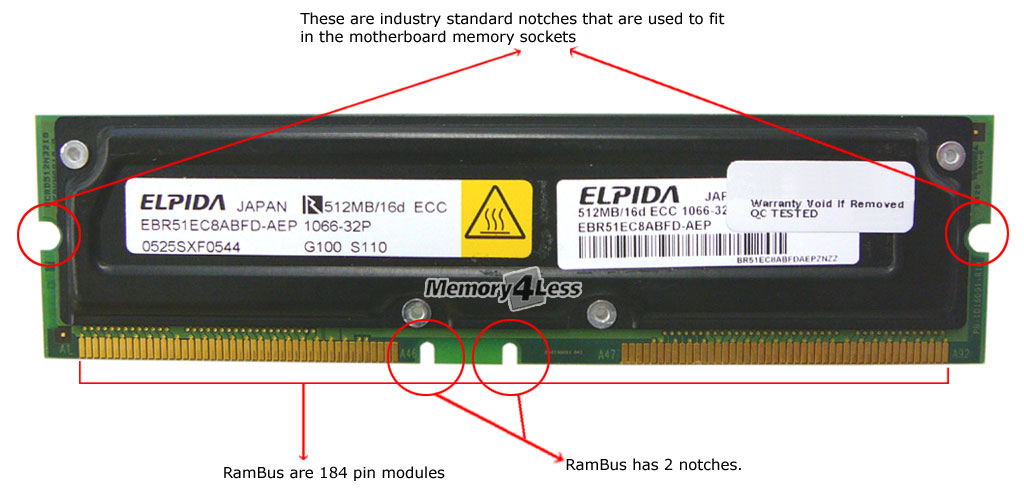
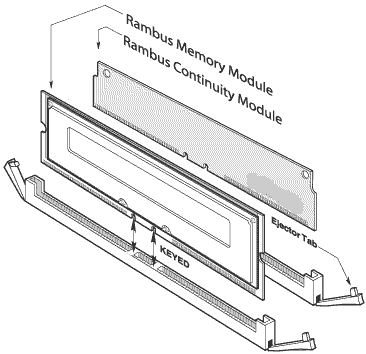
Direct Rambus DRAM or DRDRAM (sometimes just called Rambus DRAM or RDRAM) is a type of synchronous dynamic RAM, designed by the Rambus Corporation.

Rambus Dynamic RAM memory technology, was intended to replace SDRAM and challenge DDR SDRAM as the standard memory used in computers. The first PC motherboards with support for RDRAM debuted in 1999. They supported PC800 RDRAM, which operated at 400 MHz but presented data on both rise and fall of clock cycle resulting in effectively 800 MHz, and delivered 1600 MB/s of bandwidth over a 16-bit bus using a 184-pin RIMM form factor. This was significantly faster than the previous standard, PC133 SDRAM, which operated at 133 MHz and delivered 1066 MB/s of bandwidth over a 64-bit bus using a 168-pin DIMM form factor.

Some downsides of RDRAM technology, however, included significantly increased latency, heat output, manufacturing complexity, and cost. PC800 RDRAM operated with a latency of 45 ns, compared to only 7.5 ns for PC133 SDRAM. RDRAM memory chips also put out significantly more heat than SDRAM chips, necessitating heatsinks on all RIMM devices. RDRAM also includes a memory controller on each memory chip, significantly increasing manufacturing complexity compared to SDRAM, which used a single memory controller located on the northbridge chipset. RDRAM was also two to three times the price of PC133 SDRAM due to manufacturing costs, license fees and other market factors. DDR SDRAM, introduced in 2000, operated at an effective clockspeed of 266 MHz and delivered 2100 MB/s over a 64-bit bus using a 184-pin DIMM form factor.

With the introduction of the i840 chipset, Intel added support for dual-channel PC800 RDRAM, doubling bandwidth to 3200 MB/s by increasing the bus width to 32-bit. This was followed in 2002 by the i850E chipset, which introduced PC1066 RDRAM, increasing total dual-channel bandwidth to 4200 MB/s. Also in 2002, Intel released the E7205 Granite Bay chipset, which introduced dual-channel DDR support for a total bandwidth of 4200 MB/s, but at a much lower latency than competing RDRAM. In 2003, Intel released the i875P chipset, and along with it dual-channel DDR400. With a total bandwidth of 6400 MB/s, it marked the end of RDRAM as a technology with competitive performance.

Rambus survived the obsolescence of RDRAM and moved to support DDR and DDR2 in the area of video card technology and in particular, PCI-E. Rambus also developed and licensed its XDR RAM technology.


Buy more Rambus RDRAM from:www.oempcworld.com

Wednesday, October 1, 2008

MMC Mobile memory card


MMC Mobile memory card

MMC Mobile card is a reduced-sized MMC flash memory card with enhanced features specifically designed for use with mobile phones requiring low voltage and high-speed data transfer for the internal RS-MMC size memory card slot.


Features:

  • Integral MMC mobile cards are perfect for storing data from the latest mobile phones
  • MMC mobile has an extremely small form factor of 24mm x18mm x1.4mm, specifically designed to work best in mobile phones as it is space saving in size and uses a tiny amount of battery power
  • MMC mobile is a dual voltage product, operating at both 1.65-1.95V and 2.7-3.6V ranges
  • MMC mobile is fully backwards compatible with RSMMC (Reduced Size Multi Media Card) and Dual Voltage RSMMC
  • Operating at 52 MHz in x8bit mode, data can be transferred at up to 52MB/sec, (or 416 bits/sec)
  • Along with its sister format MMC plus, this is the highest data transfer rate of all existing memory card standards available today.
  • With the use of an adaptor, which Integral supply with all MMC mobile cards, MMC mobile can be made full-size and work as a standard Multi Media Card/ MMC plus in many other devices such as digital cameras, MP3 players, navigation systems and PDA's.
  • Your mobile phone will be able to store more images, ringtones, mp3s and movie clips then ever before.
  • Available in 4 Sizes: 128MB,256MB,512MB , 1GB

Visit for more information : www.oempcworld.com

Friday, September 26, 2008

SSDFC Smart Media Cards


SSDFC Smart Media memory cards

SmartMedia flash memory card is a removable flash memory card that can be used in several different types of digital devices; including digital cameras, digital music players and digital voice recorders. Smart Media flash memory is an elegently simple Flash RAM specification. A Thin Package Flash Memory IC is embedded in a card with a direct connection to the dataport. Smart Media cards from OpticsPlanet.com are fully compatible with all devices that run the Smart Media type flash memory cards. OpticsPlanet SmartMedia memory is one of the thinnest solutions for removable solid-state memory. About one third the size of a credit card and just as thin, SmartMedia is a small but durable format. Built with solid-state construction, with no moving parts that will wear down over time, our Smart Media will securely store your music, images and data.

The main advantage that SmartMedia cards have over the other memory cards is that because they read, write, and erase memory in small blocks of data (256 or 512 bytes at a time), you can more precisely select what data you want to save. Although the SmartMedia card was well received when it hit the market (especially the digital camera segment), SmartMedia cards have a few underlying weaknesses.

Capacities of SmartMedia cards are in sizes of 2mb, 4mb, 8mb, 16mb, 32mb, 64mb and top off at 128mb. Due to limited capacities, low transfer rates, it’s less sturdy encasing (compared to other flash memory card formats), the SmartMedia card has been replaced by other formats (primarily XD cards and SD cards).

OpticsPlanet.com SmartMedia has a simple structure in comparison with conventional memory cards. The NAND-type flash memory chip enhances the write and erase capabilities as data is rewritten in smaller increments. This results in improved performance through continuous data recording.
Optics Planet Smart Media card is a compact, reliable and competitive solution for today's digital devices.

SmartMedia Card Features:

* Thinnest Removable Form Factor
* SmarMedia Storage Capacities: 16MB to 128MB
* Nonvolatile Solid-State NAND Flash
* 22 Pad SmartMedia (SSFDC) Connector
* 3.3V Operation
* Low Power Consumption
* ID for Copyright Protection
* Automatic Program and Erase

Smart Media Card Applications:

* Digital Cameras
* PDA/Handheld PCs
* MP3 Players
* Word Processors
* GPS
* Cellular Phones
* Photo Printers
* Laptops

Buy more flash memory cards : www.oempcworld.com

Thursday, September 25, 2008

Olympus xD-Picture Card


Olympus xD-Picture Card (Type M and Type M+)


Olympus xD (Extreme Digital) Picture Card is the ultimate reusable, removable digital media. Besides providing increased storage capacities at higher resolutions, it also offers compatibility with most manufacturers’ xD-compatible devices and is the only xD-Picture Card to support the Panorama function found with today’s Olympus digital cameras.

The Type M and Type M+ xD-Picture Card keeps your photo, movie and other files safe and sound so you can enjoy them any way you want (viewing, sharing, slideshows, etc.) and any time. The compact size lets you carry it anywhere and because it’s compatible with many reader/writers, you can download data to a computer or another device in a jiffy.

The Type M+ xD-Picture card is compatible with all cameras and is 1.5 times faster than the Type M card. The increase in speed may be useful in sequential shooting of digital stills and in the recording of high-density video with Olympus cameras.

When it comes to your pictures, quality and reliability can’t be compromised. That’s why the xD-Picture Card is the finest compact, durable removable media your camera will ever know

The xD-Picture Card is a flash memory card format developed and introduced to the market in July 2002 by Olympus and Fujifilm, and manufactured by the Toshiba Corporation. xD cards are in Olympus and Fujifilm digital cameras, and are available in a range of sizes, from 16 MB to 1 GB currently. A higher-performance xD card known as Type M came out in 2005, and uses Multi Level Cell (MLC) architecture. The 1GB Type M card is called the M1GB (M-XD1GM). Type M cards will eventually be available in sizes up to 8 GB, though the cards are not compatible with all older model cameras.


xD cards are available from a wide variety of manufacturers, they are not the most expensive format, and they also offers many advantages.As of June 2005, the maximum size of released xD cards compares favourably to the various other flash card standards. xD cards are available in sizes up to one gigabyte. Other smaller formats Flash Cards which match xD's size more closely have lower or the same capacity.

Buy more XD Picture Cards:www.oempcworld.com

Wednesday, September 24, 2008

RAMBUS MEMORY


184-pin Rambus RDRAM RIMM

RAMBUS:
Direct Rambus is a high-speed memory technology that uses a narrow 16-bit bus (Rambus channel) to transmit data at speeds up to 800MHz. PC600: 16-bit, single channel RIMM, specified to operate at 300 MHz clock speed, 1200 MB/s bandwidth


approx. 5.25” x 1.25”

The Rambus ® RIMM™ module is a general purpose high-performance memory module suitable for use in a broad range of applications including computer memory, personal computers, workstations, and other applications where high bandwidth and low latency are required.

Features
  • High speed 1066, 800, 711 and 600 MHz RDRAM storage
  • 184 edge connector pads with 1mm pad spacing
  • Maximum module PCB size: 133.5mm x 31.75mm x 1.37mm (5.25" x 1.25" x 0.05")
  • Each RDRAM has 16 banks, for a total of 256, 192, 128, 96, or 64 banks on each 128MB, 96MB, 64MB, 48MB, or 32MB module respectively
  • Gold plated edge connector pad contacts
  • Serial Presence Detect (SPD) support
  • Operates from a 2.5 volt supply (±5%)
  • Low power and power down self refresh modes
  • Separate Row and Column buses for higher efficiency


RDRAM delivers pure performance where it matters most: leading-edge applications. Whether on multimedia, network packet switching, content creation, etc., RDRAM unleashes the processing power of your system. High-bandwidth RDRAM is essential to drive top performing processors. RDRAM provides a flexible solution to meet bandwidth requirements of tomorrow's high performance systems. RDRAMs system solution scales easily from 800Mhz to 1066Mhz to 1200Mhz. Additionally, commodity RDRAM components are configurable in a range of RIMM module configurations from 16 to 32 and 64 bit data busses. These RIMM module solutions offer up to 9.6 GByte/second of memory performance while retaining standard PC form factors.

There are 3 independent attributes that define which specification a RAMBUS module belongs to:

Clock speed: 800MHz, 1066MHz.
Latency: 45ns, 40ns, 32ns.
Bus width: 16-bit, 32-bit.

Buy more Memory :www.oempcworld.com

Tuesday, September 23, 2008

PCMCIA Compact Flash Adapter


PCMCIA Compact Flash Adapter (CGI)

Description:
PCMCIA Adapter For Compact Flash Card CF Type I for use in notebooks and music keyboards with PC Card PCMCIA slots.
CompactFlash is used in such a wide variety of appliances ranging from PDA's, digital cameras and MP3 players that if you have a portable computer or system that is capable of accepting PCMCIA - this adapter is a must have. The PCMCIA CompactFlash adapter is true plug and play, requiring absolutely no drivers or software to enable you to transfer files.

Slip a CompactFlash Type I memory card (the most popular form of CompactFlash) into the adapter and plug it directly into your laptop, notebook or PCMCIA device. The CompactFlash card then appears on your system as a additional drive e.g. Drive E: so you can cut, copy and paste files in the usual manner.

The PCMCIA CompactFlash adapter can also be coupled with a "PCMCIA to USB" adapter to create a very low cost solution to transferring your photographs or data to your desktop PC

Use it to read and write photographs or files from CompactFlash cards in the PCMCIA slot of Windows 95/98/ME/XP/2000 or Mac Notebook computer (won't work with NT). The card appears as disk drive e.g. Drive E: under Windows. No drivers required for Mac and Windows. Use this adapter and a CompactFlash card as a low cost alternative to PCMCIA ATA cards.


ALT SKU: BPJ
SKU: CGI
Module Form Factor: Flash
UPC Code: 710348915514

Buy More PCMCIA Compact Flash Adapter from :www.oempcworld.com

Monday, September 22, 2008

64MB PC133 144 pin SODIMM


64MB PC133 144 pin SODIMM


One of today's most versatile and powerful laptop memory chips are the PC100 and PC133 144-PIN SDRAM SO-DIMM modules. These cross-brand, cross-platform modules provide the best upgrade for PC100/PC133 Laptop systems. Support old as well as new models, these modules will give your Laptop that extra memory and speed boost it may have lost during its operation.


Description:

  • 144-Pin SODIMM (Dual In-Line Memory) Module
  • Pins: 144-PIN
  • Plating: Gold Plated PINS
  • TinyBga Technology Chips
  • Serial Presence Detect with Write Protect Feature
  • Voltage: 3.3V
  • CL (CAS Latency): 3
  • Clock Frequency: 133Mhz (PC133)
  • Clock Access Time: 8ns
  • Chip Configuration: 8 x 16


Technical Features:

  • Single Pulsed /RAS interface
  • Single Pulsed /RAS interface
  • Burst Type: Sequential or Interleave
  • Burst Type: Sequential or Interleave
  • Automatic and controlled Precharge Commands
  • Suspend Mode and Power Down Mode


Manufacturer's Description:

oempcworld is the world's largest memory manufacturer. In today's performance-driven environment, memory upgrades provide an easy, economical alternative to increase system performance. Every memory product oempcworld offers is designed to help you get maximum performance at the best price to you.

Buy more product from : www.oempcworld.com